Operating System :- Operating System is known as a platform between hardware and peripherials of the computer user. Every computer system must have at least one operating system to run other programs.
E.g :- Applications like Browsers, MS Office, Notepad Games, etc., need some environment to run and perform its tasks.
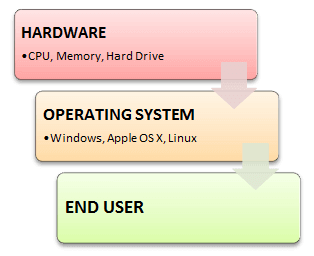
Introduction to Operating System.
History Of OS
v Operating systems were first developed in the late 1950s to manage tape storage
v The General Motors Research Lab implemented the first OS in the early 1950s for their IBM 701
v In the mid-1960s, operating systems started to use disks
v In the late 1960s, the first version of the Unix OS was developed
v The first OS built by Microsoft was DOS. It was built in 1981 by purchasing the 86-DOS software from a Seattle company
v The present-day popular OS Windows first came to existence in 1985 when a GUI was created and paired with MS-DOS.
 Below the Operating System with the latest
Market Share
Below the Operating System with the latest
Market Share
|
S Name |
Share |
|
Windows |
40.34 |
|
Android |
37.95 |
|
iOS |
15.44 |
|
Windows Phone OS |
0.06 |
|
Chrome OS |
0.14 |
|
Mac OS |
4.34 |
|
Linux |
0.95 |
Following are the popular types of Operating System:
- Batch Operating System
- Multitasking/Time Sharing OS
- Multiprocessing OS
- Real Time OS Distributed OS
- Network OS
- Mobile OS
Batch Operating System
Some computer processes are very lengthy and time-consuming. To speed the same process, a job with a similar type of needs are batched together and run as a group.
The user of a batch operating system never directly interacts with the computer. In this type of OS, every user prepares his or her job on an offline device like a punch card and submit it to the computer operator.
Multi-Tasking/Time-sharing Operating systems
Time-sharing operating system enables people located at a different terminal(shell) to use a single computer system at the same time. The processor time (CPU) which is shared among multiple users is termed as time sharing.
Real time OS
A real time operating system time interval to process and respond to inputs is very small. Examples: Military Software Systems, Space Software Systems are the Real time OS example.
Distributed Operating System
Distributed systems use many processors located in different machines to provide very fast computation to its users.
Network Operating System
Network Operating System runs on a server. It provides the capability to serve to manage data, user, groups, security, application, and other networking functions.
Mobile OS
Mobile operating systems are those OS which is especially that are designed to power smartphones, tablets, and wearables devices.
Disadvantages of using Operating System
- If any issue occurs in OS, you may lose all the contents which have been stored in your system
- Operating system's software is quite expensive for small size organization which adds burden on them. Example Windows
- It is never entirely secure as a threat can occur at any time
Difference between 32-Bit vs. 64 Bit Operating System
|
Parameters |
32. Bit |
64. Bit |
|
Architecture and Software |
Allow 32 bit of data processing simultaneously |
Allow 64 bit of data processing simultaneously |
|
Compatibility |
32-bit applications require 32-bit OS and CPUs. |
64-bit applications require a 64-bit OS and CPU. |
|
Systems Available |
All versions of Windows 8, Windows 7, Windows Vista, and Windows XP, Linux, etc. |
Windows XP Professional, Vista, 7, Mac OS X and Linux. |
|
Memory Limits |
32-bit systems are limited to 3.2 GB of RAM. |
64-bit systems allow a maximum 17 Billion GB of RAM. |
SUMMARY :-
1. Define Operating System: An operating system is a software which acts as an interface between the end user and computer hardware.
2. Operating systems were first developed in the late 1950s to manage tape storage.
Process, Device, File, I/O, Secondary-Storage, Memory management are various functions of an Operating System
Batch, Multitasking/Time Sharing, Multiprocessing, Real Time, Distributed, Network, Mobile are various types of OS
PLEASE FOLLOW ME ON SOCIAL NETWORK


No comments:
Post a Comment
NO NEED TO DO ANY SPAM ACTIVITY.